Showing posts with label Chelsea. Show all posts

Thursday, January 17, 2013

EPL Bayernly Crossed My Mind

r-PEP-GUARDIOLA-BAYERN-MUNICH-large

On Wednesday, Pep Guardiola officially announced his agreement to take on the manager’s role at Bayern Munich at the end of the season, when current gaffer Jupp Heynckes, aged 67, retires.

The decision of the 41-year-old former Barcelona legend to sign a 3-year contract with last season’s Bundesliga runners-up has been met with shock, especially in England, where media hype had fans convinced his arrival on British soil was imminent.
However, anyone with half a brain cell or a semi-respectable knowledge of the football industry will appreciate that Bayern Munich were the only club that Guardiola was ever interested in, for some painfully obvious reasons.
So, while Bayern general manager Uli Hoeness conceded, “Only a coach of Guardiola’s caliber came into consideration,” the feeling was entirely mutual on Guardiola’s behalf....
***Click here to read full article***
Written by Dom Wallace
Sport 4 Thought

Friday, May 4, 2012

Aussie Rules For Me

Sport 4 Thought guest writer Andrew Hatch goes down under to investigate what makes Australian Rules Football so wildly popular. A special report from the MCG, Melbourne.


I landed in Australia four weeks ago but only truly arrived this Saturday. 

The first weekend I was here it was suggested that I go see a game of ‘footy’ at the Melbourne Cricket Ground (MCG). The game I was meant to see was the season opener between Richmond and Carlton but it fell through for one reason or another. I would have to wait another 3 weeks before I finally got my first taste. 

So on Saturday the 21st of April I was going to see Carlton, who I was told had made a blistering start to the season and were expected to challenge for the title, play Essendon: a mid-table team who would be lucky to escape without suffering an embarrassing defeat. This as you can imagine meant nothing to me because since missing that first game a few weeks earlier I hadn’t paid the slightest bit of attention to the AFL, the game was nothing but a curiosity to me and if I’m honest I just wanted to see inside the MCG.

As a kid my only memories of ‘footy’ were seeing a bit of Aussie Rules on Channel 4’s Trans World Sport early on a Saturday morning before Going Live came on the other channel. This weird game played out on a gigantic, circular pitch befuddled me. Why were they allowed to use their hands? Why were there no nets in the goals? Why did they not have sleeves?

In the pub, (a strip bar naturally) before the game, I looked around and saw (besides the topless barmaids) Carlton fans mixing with Essendon fans. No sign of aggro, no sign of any kind of tension. Two sets of fans relaxing, drinking, talking. Nothing weird about that is there? Except for an English football fan there is a bit. Around Old Trafford there are ‘home pubs’ and ‘away pubs’. It’s not quite like Glasgow where a Celtic fan would be lucky to escape from a Rangers pub with his nose still attached to his face and vice-versa, but still, you won’t see many away fans, garbed fully in their team’s colours mind, mingling jovially with the home support. I asked my Aussie friend who the home side were; it doesn’t really work that way with footy, he told me.

Almost everything that came up in our discussions leading up to the game was related back to the Premier League in some way, partly to make the alien subject matter clearer to me and partly to manage my expectations of the game. ‘It’s not like in the Premier League’ was quickly established as the phrase of the day.

“How many can we expect there to be in the MCG today then?” I asked.
“There’ll be a big crowd, maybe 80,000, but the atmosphere won’t be anything like in the Premier League,” he said.
“It’s a big pitch for the players to cover, is the game all stop-start like rugby?” I asked.
“Oh no the game is quick, but it’s not like what you’re used to in the Premier League.”

So we approached the stadium, brushing past whole families wearing Carlton shirts, Essendon shirts and even a few Liverpool and Manchester United shirts thrown in for good measure too, with my expectation level well and truly managed. We shuffled past numerous statues of Australian sports luminaries, the majority of which I hadn't heard of, save for Don Bradman and finally got to our gate, which is when I got my first sight of the stadium.

I’ve been to some giant stadia before: the old Wembley in London, Cardiff's Millennium Stadium and of course Old Trafford in Manchester but I have to say that the Melbourne Cricket Ground is the biggest, grandest, most dramatic stadium I have ever seen. The sounds were equally impressive, both sets of fans (seated together) were getting warmed up and in terrific voice creating not so much a wall of sound but thanks to the stadium’s bowl shape, more of an enormous ball of sound that seemed to swell and linger on the pitch and could find no means of escape.

Never mind ‘not like the Premier League’, this was better.

Immediately I knew that this game, this strange hybrid of football and rugby, would compel me. And I was right. 

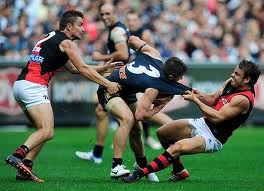
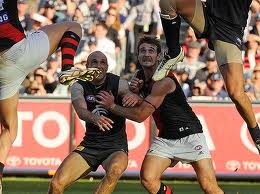
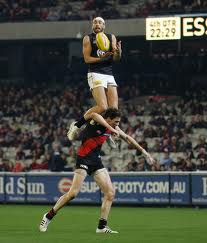
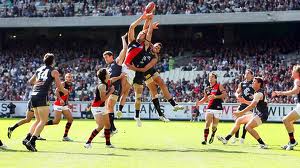
From the first siren I was impressed by the athleticism of these players. They sprint and leap and twist and turn with such ferocity and under such immense pressure. You think it’s impressive how Xavi engineers space, giving himself time to play his pass perfectly? Then you ought to see for yourself how quickly these men can receive the ball (more often than not at terribly awkward heights), find a teammate and offload it (in the legal manner: ‘knocking’ the ball with the fist) before two or three hulking men come crashing down on them. And have you ever tried sprinting whilst bouncing a rugby ball on the ground every 15 metres like you’re playing basketball? Not easy.

Anyone who knows me knows I’m not a huge fan of rugby. I've been to a few Premiership games before, but the game just never grabbed me. I find the reliance on brute strength and physical attributes disheartening and prefer my winners to be the ones who were more wily, more creative on the day, not just simply faster, stronger or fitter (hence why I prefer the technique of a Federer to prevail over the brawn of a Nadal, the guile of a Barcelona to the dull, if determined, discipline of a Chelsea). I appreciate there are nuances to the game, that in my ignorance I do not understand and intricacies in skill that I just cannot see, but I will never be a fan.

I expected ‘footy’ to be more like rugby than like football. I expected the physical attributes of the players to have more of a bearing on the outcome than their wit and skill.

What I actually found was that ‘footy’ is almost the exact half-way point between rugby and football. It is required for the players to be on the whole tall, muscular, quick on their feet and tough, but at the same time I can not imagine, having seen this game first hand, a player succeeding at the top level without being able to marry these attributes to nimble hands and an exceedingly quick mind. It can appear at times as if they are merely playing hot potato but when you take a look at the wider picture and see the intricately set out patterns of the players and the almost telepathic knowledge of where their teammates should be positioned, it’s pretty obvious that there’s more to it than that.

Even the referees are athletic in this game. They need to be. The way they throw the ball back into the pitch when it has gone out of touch is amazing. They stand on the touchline with their back to the pitch, swing the ball low between their legs and fling it as hard and high as they can over their head, a sort of backwards tossing the caber motion. Most of the refs in the Premier League would put their backs out trying it.

I needed no more comparisons with the Premier League to be made once the game got under way. There were passages of play remarkably similar to those you might see in a football match with intricate one-twos being played, play being switched from one flank to the other, through balls being kicked in behind defences. At one point I even noticed how high the Carlton defence were up the pitch and remarked to my friend how dangerous that was given the pace Essendon’s forwards had displayed. My prophecy instantly came true and Carlton were hit on the counter attack on more than one occasion and trailed at half time. I felt right at home. 

I expected the game, due to the size of the pitch (2.8 times the size of a regulation association football pitch), to be played out at a relatively sedate pace. It was not. It was fast, intense, frenzied action for each of the four 30 minute quarters. Towards the end of the last quarter, some of the players were visibly tiring but only indulged in putting their hands on their knees or behind their heads during breaks in play. It was astounding stuff really. The fitness levels of these players is nothing short of freakish. Carlos Tevez would have needed more than a few run outs with the reserves to get up to speed in this game.

There was a moment where the referee felt it necessary to refer to a video. The footage required was shown on the big screen, high up in the stadium’s massive third tier and within quite literally three seconds he’d blown his whistle, made the call and the game was gotten on with. Another lesson to be learnt for the Premier League?

The game finished in a sound defeat for Carlton. Essendon’s supporters were delirious. The stadium rocked with noise. I was hooked.

This game, which began largely as a regional passion for Victorians, quickly outgrew it’s native state to encompass the whole of Australia, evolving from the Victorian Football League (VFL) into it’s current guise as the Australian Football League (AFL) in 1990. With the right backing, perhaps similar to that which saw the Football League morph into the behemoth that became the Premier League in 1992, who is to say that this hugely entertaining game couldn’t one day prove every bit as popular?

I’ve already asked my friend for tickets to the next Carlton match.

Written by Andrew Hatch

Tuesday, April 17, 2012

Goal-Line Technology Not Welcome in Football

F.A. Cup confusion
The debate surrounding goal-line technology in football has surfaced once again, following a phantom goal during Chelsea’s F.A. Cup semi-final victory over Tottenham at Wembley on Sunday. At the time of the goal, The Blues held a slender 1-0 lead, but following the absurd refereeing blunder, they went on to complete a 5-1 demolition of a bemused and bewildered Spurs side. As predicted, many of football’s greats, past and present, took to their social networking sites of choice to air their grievances regarding the latest high-profile controversy, as the introduction of goal-line technology appears increasingly imminent.

But, would this really improve the game of football?

As stated in Law 10 ‘The Method of Scoring’ on page 32 of the official FIFA ‘Laws of the Game’ manual: “A goal is scored when the whole of the ball passes over the goal line, between the goalposts and under the crossbar.” 

At present, this is a judgement call made by the referee and assistant referee, whose view is potentially obscured by players, leading to the belief that introducing technology would eradicate such issues.

FIFA is currently testing two potential camera-based methods, including ‘Smart Ball’ and ‘Hawk-Eye’.

The former refers to balls equipped with censors and magnetic fields around the goal to give a real-time verdict on whether or not the ball has crossed the line.

Lampard out of luck
A similar system was trialled by FIFA in 2005 and discarded upon learning of just a 95 percent accuracy rate.

The latter system uses triangulation, through six high-speed cameras, only needing to observe 25 percent of the ball to determine its location, overcoming the concern of players blocking the line of vision.

However, this is not real-time and would therefore require stoppages in play for disputed incidents. Cost of installation has also been estimated at £250,000 for each stadium to utilise such technology. 

In this instance, a greater divide between the Premier League and the lower leagues would be created, an act which would be frowned upon by those unable to afford such facilities. It seems difficult to justify the costs of implementation for a scenario which is relatively rare.

True, most big-money sports in the modern era take advantage of technology to aid decision making, including finish line calls in horse racing, swimming and athletics. Cricket and tennis both use Hawk-Eye for in-line judgements, whilst rugby employs video referees for dubious try decisions.

To many general sports fans, football may appear to have been left in the dark ages, but all dedicated football fans will appreciate the one resounding difference between their favoured discipline and the others mentioned above.

Keeper 'saves' a goal
Football is the only non-stop sport, whereby breaks in play are few and far between and the very ethos of the game is based on hard, fast, flowing action. To introduce lengthy stoppages, interrupting the natural rhythm of the game, would be to remove the heartbeat of a sport which has survived perfectly well throughout the ages, without the need for such inclusion.

The most famous case in recent history occurred in the 2010 World Cup in South Africa, when Frank Lampard’s 20-yard strike was judged not to have crossed the line, despite video replays showing the ball was a foot over the chalk.

Sure, England had reason to feel hard done by, but the fact remains, they were horrendously outclassed and convincingly defeated 4-1 by much classier opponents. So, rather than being a decision that changed the outcome of England’s World Cup fortunes, it became an event that was used as a scapegoat to mask England’s lack of talent.

Similarly, on Sunday, Tottenham were equally unlucky to have a goal awarded against them, which never crossed the line. But, despite Chelsea scoring on four other occasions, in an impressive 5-1 rout, it was the irrelevance of the goal that never was, which stole the headlines.

As with these two instances, there would be little to no overall change of the successes and failures in the football world.

The 1966 World Cup Final
The one major argument in favour of goal-line technology is justice. The problem being, the use of technology for one scenario creates inconsistencies in others.

For example, a referee may possess the power and knowledge to award a goal after confirming, through video replay, that the ball has crossed the line. Yet, if the corner that lead to the goal should never have been given, because video replays show the defender never touched the ball, it is impossible to claim justice in this situation.

The only way to achieve real justice throughout football is through the total use of computerised, video-assisted, robotic referees for every single decision, including throw-ins, free-kicks, corners, goal-kicks, penalties and goals causing uncountable stoppages and the complete death of the game.

Yes, sometimes humans get decisions wrong and sometimes they go in your teams favour and sometimes they do not, but this is part of the game. 

Genuine football fans would agree that half the enjoyment of being a spectator, is the debates that ensue over the referee’s big calls. As the president of FIFA, Sepp Blatter, claimed, “Fans love to debate any given incident in a game. It is part of the human nature of sport.”

FIFA not keen on cameras
FIFA have always claimed their objective is to open up football to the world, a notion that is made impossible by the undermining of its universality. 

The idea of an ancient sport being replicated all over the planet, promoting ‘jumpers for goalposts’ football, is removed with the suggested inclusion of complex modern goal-line technology.

After all, football is an art, not a science.

Written by Dom Wallace

Tuesday, March 6, 2012

Who Dares Cross the Bridge?

An unhappy ending
With Andre Villas-Boas becoming the seventh manager to lose his job since the Roman Abramovich regime commenced in 2003, speculation surrounds who is being lined up to cross the bridge that has seen so many stumble and fall. The following candidates top the Chelsea wish list:

JOSE MOURINHO – 49, Real Madrid

The main target
‘The Special One’ is the players and fans favourite to return to Stamford Bridge, where he previously won six trophies, including two Premier League titles, crowning him Chelsea’s most successful manager ever.

Mourinho has made no secrets of his desire to return to the Premier League and amidst rumours of increasingly strained relations with Real Madrid’s big name stars, he was spotted house-hunting in London last week.

However, with Arsene Wenger’s job in the balance at Arsenal and the possibility of Harry Redknapp trading Tottenham for England, the media frenzy has flown into overdrive.

Mourinho has also been linked with both Manchester clubs, although with Man City’s current form and Sir Alex Ferguson’s good health, these posts are showing little sign of availability.

With a history of achieving his goals and moving swiftly on, Mourinho has suggested his next visit to England will be in a long haul capacity, citing Ferguson’s reign as inspiration.

The problems at Chelsea cannot be immediately resolved and the Chelsea faithful will be hoping this is the perfect project for him to take on with his experience and deep-rooted love for the club.

Although there would be the small task of resolving ‘philosophical differences’ with Abramovich...

PEP GUARDIOLA – 41, Barcelona

Highly regarded
Despite boasting the capture of every possible trophy as both player and manager at Barcelona, Guardiola has always kept his options open, only ever signing one-year contract extensions.

He openly admits a fondness of Premier League football, expressing a desire to tackle alternative cultures and if Barcelona win their third Champions League title in four seasons this year, it might be a perfect way to move on.

However, with Real Madrid looking favourites to win La Liga, this would be considered a low point and it remains hard to see him parting company with what is arguably one of the greatest football outfits of all-time.

Does he really want to confront the headache of a floundering Chelsea team in desperate need of refurbishment - a role offering an average shelf life of under 12 months?

RAFAEL BENITEZ – 51, Unattached

Controversial choice
Most short-term memories of Benitez are not particularly impressive, with an unsuccessful short-lived spell at Inter Milan and a troubled time prior to his departure at Liverpool.

Those whose football knowledge extends further than this will vouch for Benitez and his tactical shrewdness which saw a prosperous tenure at Valenica before guiding Liverpool to Champions League success in 2005 and running Manchester United close for the Premier League title in 2008/09.

Benitez has the experience of winning the Champions League, the trophy that Abramovich so desperately wants to capture and also has the ability to get the best out of fellow Spaniard Fernando Torres who has so-far flopped at Chelsea since his £50M transfer.

The biggest issue with this appointment would be how the Chelsea fans would greet a man who they associate with relative failure at Liverpool. Benitez was also a hate figure for Chelsea fans during his time at Liverpool following controversial Champions League semi-finals in 2005 and 2007.

This will not concern Abramovich, though he may do well to remember the sour relationships Benitez formed with board members at Valencia and Liverpool, concerning his campaign for increased control of transfers.

FABIO CAPELLO – 65, Unattached

Outsider
Recently standing down from his post as England manager, Capello has reappeared on the market and may offer Abramovich just what he needs.

Capello is hard-headed and refuses to be flustered by big egos and the diva-like behaviour that seems to accompany modern football’s superstars.

A Champions League victory with AC Milan over Barcelona in 1994 and domestic success in Spain with Real Madrid combine with his role as England manager to complete an extremely well-rounded CV.

Capello in an unemotional figure who always put the team’s fortunes ahead of personal battles and this could be the refreshing approach that Chelsea are in need of.

ROBERTO DI MATTEO – 41, Chelsea (Caretaker)

A passionate figure
Still popular at Stamford Bridge, Di Matteo is most notably remembered for his two FA Cup-winning goals for the Blues in 1997 and 2000.

Di Matteo is currently installed in a caretaker position and has recruited fellow ex-Chelsea midfielder Eddie Newton to form a management duo that aims to use knowledge and passion for the club, which seems to have lost all sense of identity, to turnaround their old employer’s fortunes.

Di Matteo had a successful role at Milton Keynes Dons and started brightly at West Bromwich Albion before a rapid decline in form saw him relieved of his duties less than a year into his contract.

Di Matteo is unlikely to carry this role any further than the end of the season, although if he were to guide Chelsea to the much coveted fourth position or even mastermind a victorious cup campaign, Abramovich may be persuaded that someone with long-standing ties to the club is the answer to the new revolution.


A self-inflicted headache
Whether any of these candidates are available or suited for the role is debatable but one certainty remains. Whoever Roman Abramovich chooses, we can safely assume the next appointment will be made on the basis of experience and not potential.

Written by Dom Wallace

Wednesday, February 8, 2012

Comeback Kings Fight to Keep Crown

Manchester United staged a stunning fightback in an enthralling encounter at Stamford Bridge, leaving Chelsea bewildered, staunchly reminding critics to doubt them at their own peril.

Alex Ferguson has vehemently denied that his current squad lacks the class of previous sides, although their faltering progress in cup competitions this term is evidence against such claims.
Perfect execution from Mata

Yet when United produce a display such as they did in the second half against Chelsea, correcting a three goal deficit, it serves as a firm implication that they will not relinquish their crown with ease.

A Jonny Evans own goal put the home side ahead, with a scintillating strike from Juan Mata and a deflected David Luiz header sailing Chelsea into a three goal lead and the Stamford Bridge faithful into a frenzy.

But the game was not finished and neither were Manchester United.

Clumsy defending from the home team and a touch of good fortune allowed Wayne Rooney to convert two penalties, with a dramatic header from Javier Hernandez sparking scenes of jubilation for the visitors.

Chelsea could have snatched a winner, but David de Gea defied his critics with two stunning saves in the dying minutes, from a wonderfully executed Mata free-kick and a powerful drive by debutant Gary Cahill.

An enticing spectacle for the neutral and a wonderful advert for Premier League football, the contest was summarised by Alex Ferguson, as a game that “epitomises English football”.

Welbeck earns soft penalty
The outcome saw the champions fall two points adrift of neighbours Manchester City in the title race, but given the context of the game, United will view this as one point gained in a match showcasing their famous never-say-die attitude.

For Chelsea, it was a missed opportunity to solidify their position in the top four as they remain just a solitary point ahead of fifth place Newcastle.


Chelsea had never failed to win a game in which they had led by three goals, but a defence void of injured captain John Terry and suspended full-back Ashley Cole, always looked delicate.

A cagey atmosphere saw Rio Ferdinand booed with every touch of the ball and Alex Ferguson as animated as ever, following Cahill’s last ditch tackle on Danny Welbeck.

Rooney nets from the spot
First contact was outside the box but the former Bolton man found himself extremely fortunate to escape unpunished by the clumsy challenge, admitting he was “slightly fortunate to get away with that one”.

Despite United’s apparent dominance it was Chelsea who took the lead, when Daniel Sturridge skilfully outwitted Patrice Evra, seeing his cut-back deflected into the United net via the torso of Evans..

What promised to be a tight clash in the second half was anything but that for the opening thirteen minutes.

With only twenty-four seconds on the clock, Patrice Evra was caught wondering wildly out of position, not for the first time this season, allowing Torres to gather the ball unchallenged on Chelsea’s right flank. The Spaniard looked up once, sending a missile directly onto the boot of his fellow countryman at United’s back post, where Mata slammed home to double their lead.

Four minutes later, Mata turned provider, delivering a fizzling free-kick, met by a rising David Luiz, whose header deflected off Ferdinand into the top corner, wrong-footing the helpless De Gea.

Hernandez heads home
Evra’s desire is unquestionable, however, having contributed in part to all three Chelsea goals, Ferguson will surely have stern words with his skipper prior to facing Liverpool on Saturday.

With United dazed and confused, Chelsea fans began their celebrations, only to be halted by a penalty awarded to the visitors when Sturridge carelessly clattered into Evra just before the hour.

With mixed fortunes from the spot this season, Rooney made no mistake this time, thrashing the ball into the top corner à la Shearer. He returned to the centre circle instantly, illustrating his belief that there was more to come.

He was right.

De Gea denies Mata
A hungry Welbeck battled with Branislav Ivanovic in the area, leading to the award of United’s second spot-kick, though the replay suggested minimal contact and André Villas-Boas labelled the decision “absurd”.

Rooney kept his cool once again, despatching the ball to Cech’s left as he leapt in the opposite direction.

Chelsea players, aggrieved at the soft nature of referee Howard Webb’s penalty decision, appeared to self-destruct. Villas-Boas replaced a disgruntled Sturridge with Oriol Romeu, a negative substitution further handing momentum to United.

Ex-Chelsea boss Jose Mourinho declared his frustration on numerous occasions with regard to lesser teams “parking the team bus” in front of goal to prevent superior opposition from scoring. Ironically, this was the modern Chelsea’s tactic and it failed.

Paul Scholes enjoyed a cameo role, exhibiting a flawless array of passes, but it was his only senior teammate Ryan Giggs that provided the pinpoint cross for Hernandez to nod United onto equal terms.

De Gea went someway to recovering his heavily tarnished reputation with two highly acrobatic displays, reiterating his shot-stopping skills and while question marks still remain over his aerial ability, he earned some welcome respite from his critics.
Villas-Boas left frustrated

An explosive second half culminated in stalemate, but owing to the manner of the result, Chelsea’s players trudged off the pitch in disappointment having sacrificed such a handsome lead.

As the current champions continue to be lambasted by some section of the media who will talk of two points dropped, their rivals will have viewed their spirited performance as a sign of danger that their best is yet to come.

Wayne Rooney spearheaded United’s assault, epitomising his manager’s tenacious character and even showed shades of Ferguson in his post-match interview, stating,  “We fought well and that point could win us the league… all the City players sitting there at home won't have enjoyed watching us recover, the way we fought back and the spirit of the team.”

As the march towards 'squeaky-bum time' gathers pace, City maintain the upper hand, but Rooney issued a kind reminder that United, inadequate as they may be, "will be there right to the end".

Written by Dom Wallace

Saturday, February 4, 2012

Terry Told to Take a Break

Moment of controversy
The English Football Association has confirmed that Chelsea’s John Terry has been stripped of his English captaincy until further notice.

The controversial London-born hardman is currently facing allegations of racial abuse, dating back to October in an incident at Loftus Road, involving Anton Ferdinand.

The 31-year-old centre-back has pleaded not guilty to charges that have forced the FA to remove him from his duties and not for the first time.

Terry was disciplined in similar fashion two years ago, following allegations of an affair with former teammate Wayne Bridge’s ex-girlfriend, but was surprisingly reinstated just thirteen months later.

Capello backed Terry
With the current case adjourned until July 9th, the FA released a statement informing the media that, “it is in the interests of all parties that John has the responsibilities of captaincy removed at this time.”
  
The FA based the decision on the, “high profile nature of the England captaincy, on and off the pitch”, teamed with the demands of the role prior to and during Euro 2012.

Sports minister Hugh Robertson echoed these sentiments, admitting, “It would have been impossible for John Terry to have continued as captain with this charge over his head.”

Terry in trouble
Fabio Capello has publicly stated his view that Terry is innocent until proven guilty and that he should remain available for selection as England captain.

However, the manager was not involved in the board meeting, which unanimously voted for Terry to be stood down, though the FA were keen to reiterate that, “This decision in no way infers any suggestion of guilt in relation to the charge made against John Terry.”

It is understood that Capello respects the authority of the board and will retain the power to select the successor.

FA Chairman David Bernstein is insistent on a zero-tolerance policy on racism and was encouraged by senior members of the committee to take definitive action over the sensitive nature of this case.

Terry maintains the backing of Chelsea boss Andre Villas-Boas who insists, “John is a person of good mental strength and great personal convictions.”

Owing to a knee injury, Boas is unable to select his captain for tomorrow’s clash with bitter rivals Manchester United, a contest that would have seen him go head-to-head with Anton Ferdinand’s brother, Rio.

Ferdinand says no

Primed by some sections of the media as an obvious candidate to take over as England skipper, Ferdinand has openly refused to take on the role, stating, “I just want to concentrate on playing for Manchester United.”


Ferdinand was controversially removed as captain when Terry was initially reinstated, adding to possible tensions, but amidst all the hype,  Manchester United manager Alex Ferguson has advised his player to “rise above” the media frenzy.
Ferguson even suggested that if Terry were to face United, Ferdinand “has got nothing to be ashamed of if he does decide to shake John Terry’s hand.”

Whilst journalists across England jump for joy as yet another scandal in the football world unfolds publicly, genuine fans of the national team will be nothing short of seriously concerned, with Euro 2012 looming.

After a woeful performance at the World Cup in South Africa in 2010, high expectations will fall on England’s shoulders, who are still to add to their solitary success in major tournaments, dating back forty-six years.
England fail at World Cup '10

An apparent division within the camp lead to failed performances in South Africa and England fans must be feeling apprehensive that similar excuses may be reused if the national side once again fails to deliver.

As with England’s repetitive disappointment, there appears to be an unpleasant familiarity to the latest chapter of the John Terry saga.

Written by Dom Wallace